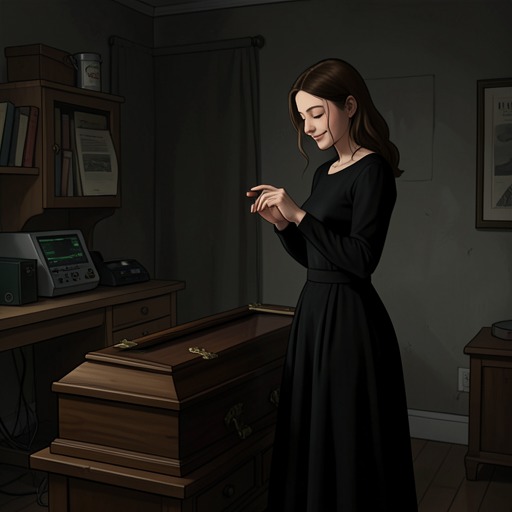
Deborah Hartsfield
Mr. MercedesDeborah Hartsfield, also referred to as Mrs. Hartsfield, is Brady Hartsfield’s mother. The investigation encounters her most directly after her death, but the evidence she left in her bedroom and on her laptop gives her an important presence in the search for information about Brady. Her stored records suggest a mother who kept close track of her adult son, while the computer itself becomes a possible route into his systems.
Identity and Family
Deborah is identified as Brady’s mother. A photograph later found among her belongings bears the handwritten caption “Mom and Her Honeyboy, Sand Point Beach, Aug 2007.” The affectionate wording and dated snapshot preserve a family image of the pair, while the discovery of the photograph becomes a practical clue when Holly Gibney tries searching Deborah’s computer for the word “Honeyboy.”
Deborah’s name also becomes a point of attention during the search. When Holly speaks to K. William Hodges by phone, she specifies that the woman’s name is Deborah Hartsfield, with an H at the end of Deborah. The correction establishes the form of her name as the investigation discusses her and underscores Holly’s precise, literal approach even amid a tense inquiry.
Death and Discovery
Hodges finds Deborah dead in her bedroom. The coverlet has been pulled over her, and a search beneath the bed turns up only slippers, pink sneakers, a single white ankle sock, and dust. He then draws back the coverlet, examines her arm, and tells Jerome Robinson that Mrs. Hartsfield is dead. Jerome’s voice cracks as he reacts to the news.
The discovery changes the investigation’s immediate circumstances: Deborah is no longer a person who can be questioned, and what the investigators can learn about her household depends on the traces she left behind. Holly is composed enough to take part in the response, but the death is treated as a serious and unsettling development rather than as a detached clue.
Records and the Investigation
Deborah’s laptop draws Holly’s attention because she hopes it may contain information about access to Brady’s computers. Holly asks to bring the laptop with them, explaining that Deborah might have written down keyboard prompts or a voice-access password. Her suggestion turns a personal object into a possible investigative resource: Deborah’s habits of record-keeping may provide a way past the barriers surrounding Brady’s computer system.
A photograph captioned “Mom and Her Honeyboy” points Holly toward a search term. Searching for Brady produces several results, including recipe entries and items marked as his favorites, but nothing immediately useful. Jerome suggests “HONEYBOY,” and the search locates a document buried deep in the hard drive. The connection between a family photograph and a computer search demonstrates how Deborah’s personal materials can serve both as evidence of family life and as an index into her stored files.
The document is a detailed record of Brady’s life. Deborah has kept his clothing sizes, lists of Christmas and birthday presents bought over the past ten years, his Social Security number, scanned copies of his car registration, insurance card, and birth certificate, and the names of his co-workers at Discount Electronix and Loeb’s Ice Cream Factory. Beside Shirley Orton’s name she has written a wondering note about whether Shirley is Brady’s girlfriend. The records are unusually comprehensive for a grown son’s life, and Holly reads them as evidence that Deborah knew he was not right. Jerome, by contrast, voices disbelief that a mother would keep so much information about an adult child.
The Laptop and Digital Surveillance
The laptop also contains a program called Looking Glass, concealed in Deborah’s Mail Contacts. Holly identifies it as a slave program that could not, as far as she knows, turn on a computer by itself, but could let someone operating another computer control a machine already switched on. Its functions include opening files, reading email, viewing search histories, and deactivating programs. Jerome connects those capabilities to the possibility that someone could have used it after Olivia Trelawney was dead; Holly responds with a grimace. The episode does not establish who installed the program or precisely how it was used, but it shows that Deborah’s computer contains a means of remote access with potential relevance to the investigation.
Deborah’s laptop therefore has a double significance. It preserves the domestic record of a mother tracking gifts, sizes, documents, and acquaintances, while also holding software that exposes the vulnerability of private information to remote access. The investigation moves between these functions: Holly reads the machine as a storehouse of family details and as a technical object that may help explain how Brady’s digital world could be reached or manipulated.
Narrative Role
Deborah is characterized chiefly through the surviving evidence of her attention to Brady rather than through an extended account of her life. The photograph gives that attention an intimate, affectionate image; the hard-drive document renders it systematic, itemized, and almost archival. Together, these traces resist a simple separation between family memory and investigative evidence: a caption supplies a search term, and a private inventory becomes a clue to Brady’s circumstances.
Her death closes off direct testimony, yet does not erase her influence on the investigation. The laptop, photograph, and meticulously maintained document continue to shape what Holly and the others can discover. Deborah’s presence in the story is thus largely posthumous and material, carried forward by objects that reveal both the closeness with which she watched her son and the information that closeness preserved.